A car accident lawyer, also called a car accident attorney or auto accident attorney, represents people in legal matters arising from motor vehicle collisions. The work can involve personal injury, property damage, insurance claims, disputed fault, settlement negotiations, and civil litigation. Personal injury law addresses harm to a person, including physical and psychological injury, within the broader field of tort law.¹
The central questions are practical: who may be legally responsible, what evidence supports the claim, which insurance policies may apply, and what losses can be documented. A collision can create several different matters at once: vehicle repairs, medical bills, missed work, an injury claim, and a dispute about coverage. Each may follow a different process.
In the United States, licensing, liability rules, insurance requirements, and filing deadlines depend heavily on state law. National statistics provide context for road injuries; they do not establish the value or merits of an individual case.
Contents 16 sections
- What a car accident lawyer does
- Types of car accident claims
- U.S. car accident statistics and insurance data
- Fault, negligence, and legal liability
- Evidence in a car accident claim
- Injuries, medical records, and recovery
- Insurance coverage and the claims process
- Compensation, damages, and settlement value
- Contingency fees and case expenses
- State laws and filing deadlines
- Settlement negotiations and car accident lawsuits
- How to choose a car accident lawyer
- Preparing for a car accident lawyer consultation
- Glossary of car accident law and insurance terms
- Sources and editorial method
- Footnotes
What a car accident lawyer does
A lawyer evaluates the facts, identifies potential claims and defendants, explains legal options, and helps the client make informed decisions. An engagement may cover investigation and negotiation, or extend through a lawsuit, trial, and appeal. The written agreement should identify its scope.
Representation also involves decisions about objectives and authority. Under the American Bar Association's Model Rule 1.2 framework, the client decides whether to settle a matter. A lawyer supplies advice about the offer, the evidence, and the risks of continuing. The ABA rules are models; the applicable jurisdiction's adopted rules govern actual conduct.²
Useful questions at the outset include who will handle the file, what work the firm will undertake, whether property damage is included, and whether a separate agreement would be needed for an appeal. The person answering an initial inquiry may not be the attorney who would conduct negotiations or appear in court.
Claims, lawsuits, and legal representation
An insurance claim is a request for payment under an insurance arrangement. A lawsuit is a civil court proceeding. Opening a claim does not itself file a lawsuit, and receiving a claim number does not identify every legal deadline.
Not every collision calls for the same level of legal work. A consultation can be especially useful when injuries are serious, responsibility is disputed, several vehicles are involved, coverage is uncertain, or a release has been proposed. These are reasons to investigate the situation, not automatic findings that a valid or valuable claim exists.
Types of car accident claims
The collision description provides a starting point for investigation. It does not settle fault by itself. The following questions illustrate how the same broad topic can lead to different evidence needs.
| Collision or situation | Questions for the investigation |
|---|---|
| Rear-end collision | What were the vehicle positions, following distances, brake inputs, and traffic conditions? Is there video of the sequence? |
| Intersection or left-turn crash | Which traffic controls applied? What do witnesses, signal information, and photographs show about movement and visibility? |
| Sideswipe or lane-change collision | Where were the vehicles before contact? Are lane markings, merge signs, blind spots, or construction relevant? |
| Multiple-vehicle crash | What was the order of impacts? Which injuries or damage can be connected to each impact? |
| Hit-and-run collision | Can the vehicle or driver be identified? What police, witness, camera, and insurance information is available? |
| Passenger, pedestrian, or cyclist injury | Which vehicles and policies may be involved? What evidence establishes the person's location and movement? |
| Rideshare, delivery, or work vehicle | Who owned the vehicle, what trip was underway, and what employment, app, or insurance records exist? |
Employer liability and work-related crashes
The doctrine of respondeat superior can make an employer responsible for an employee's wrongful act within the scope of employment. States use different tests, so a commercial logo or delivery bag alone does not establish employer liability. Employment status, the purpose of the trip, and the relationship between the driver and business require investigation.³
A person injured while working may also have a workers' compensation matter. Workers' compensation is a statutory benefits system with rules distinct from a negligence lawsuit. Whether a separate claim against a driver or another third party exists is a different question from eligibility for employment-related benefits.⁴
Vehicle defects and wrongful death
Where a suspected vehicle or component defect contributed to harm, the legal analysis may include product liability. Design, manufacture, and warnings are distinct potential issues; the available theories can include negligence, strict liability, or warranty. An injury or a recall is not, by itself, a complete proof of a product claim.⁵
After a fatal collision, a wrongful death claim may address losses suffered by legally eligible survivors. The governing statute determines who may bring the action and what may be recovered. Civil responsibility is distinct from a criminal prosecution arising from the same event.⁶
U.S. car accident statistics and insurance data
Road-safety counts measure crashes, people, and exposure. Insurance statistics measure claims or insured vehicles. Research models estimate phenomena that may be difficult to observe directly. Keeping those units separate is essential when interpreting the scale of car accident injuries.
National crashes, injuries, and deaths in 2024
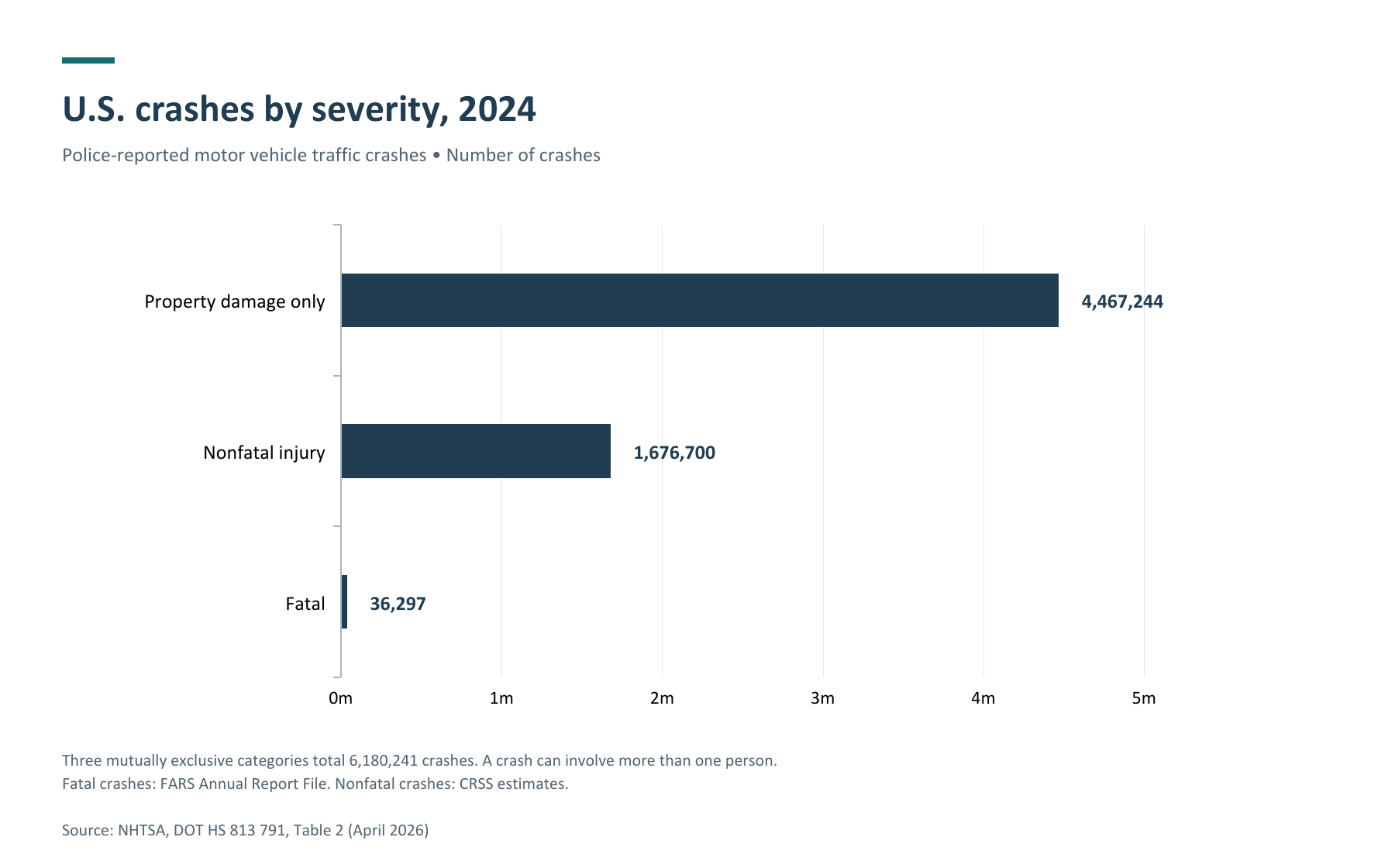
NHTSA's April 2026 overview reports 6,180,241 police-reported traffic crashes, 2,422,195 estimated injured people, and 39,254 deaths in 2024. The fatality rate was 1.19 per 100 million vehicle miles traveled. Its crash-severity categories appear below. Fatalities use the 2024 FARS Annual Report File; nonfatal estimates use the Crash Report Sampling System.⁷
| 2024 crash severity | Number of crashes | Share of total, calculated |
|---|---|---|
| Property damage only | 4,467,244 | 72.3% |
| Injury, nonfatal | 1,676,700 | 27.1% |
| Fatal | 36,297 | 0.6% |
| Total | 6,180,241 | 100.0% |
Fatality trend and the preliminary 2025 estimate
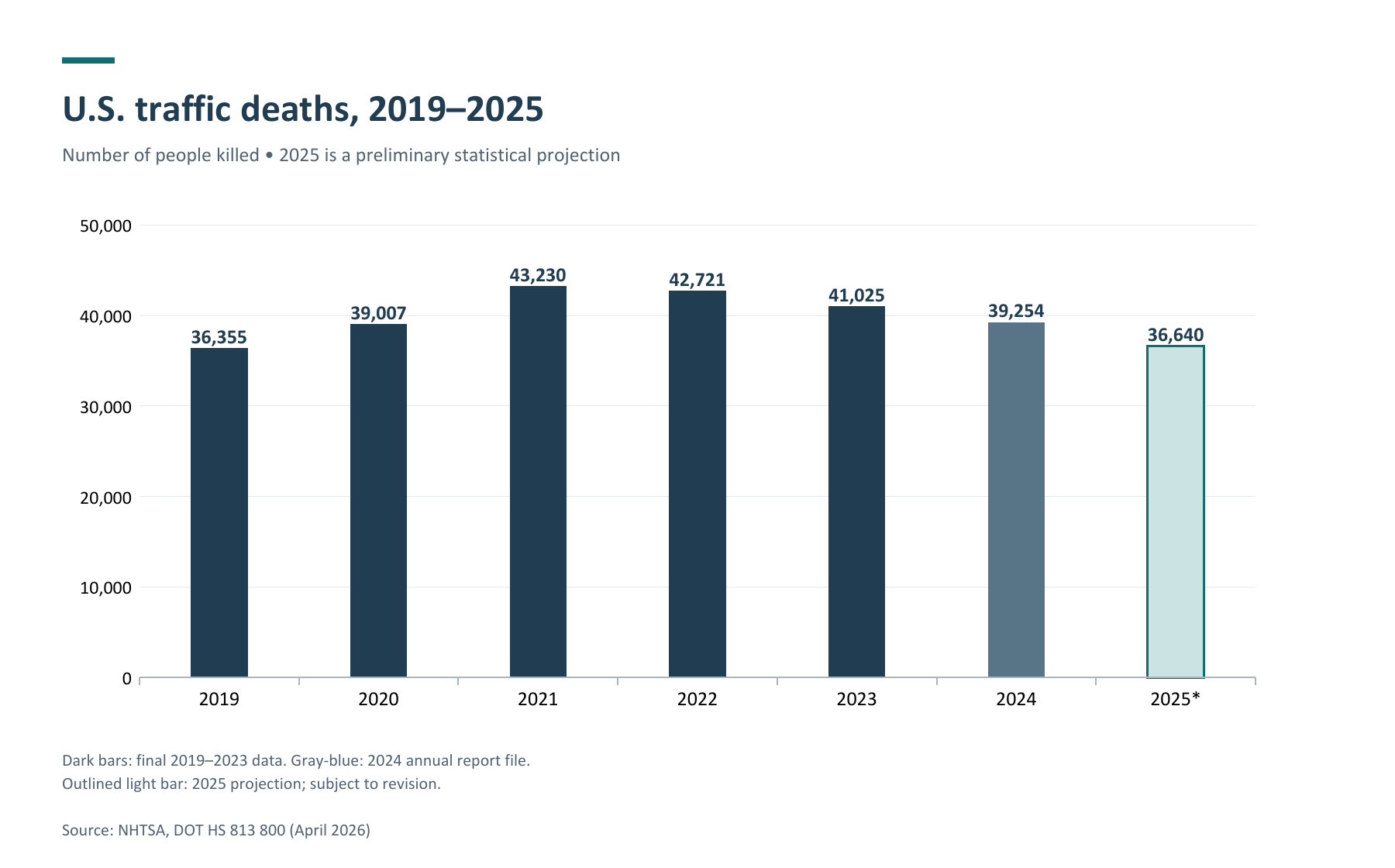
NHTSA's April 2026 early estimate projects 36,640 traffic deaths in 2025, a 6.7% decline from 2024, and a rate of 1.10 deaths per 100 million vehicle miles. The chart uses final data for 2019–2023, the annual report file for 2024, and the separately marked projection for 2025. The projection may be revised.⁸
Alcohol impairment, speeding, and distraction
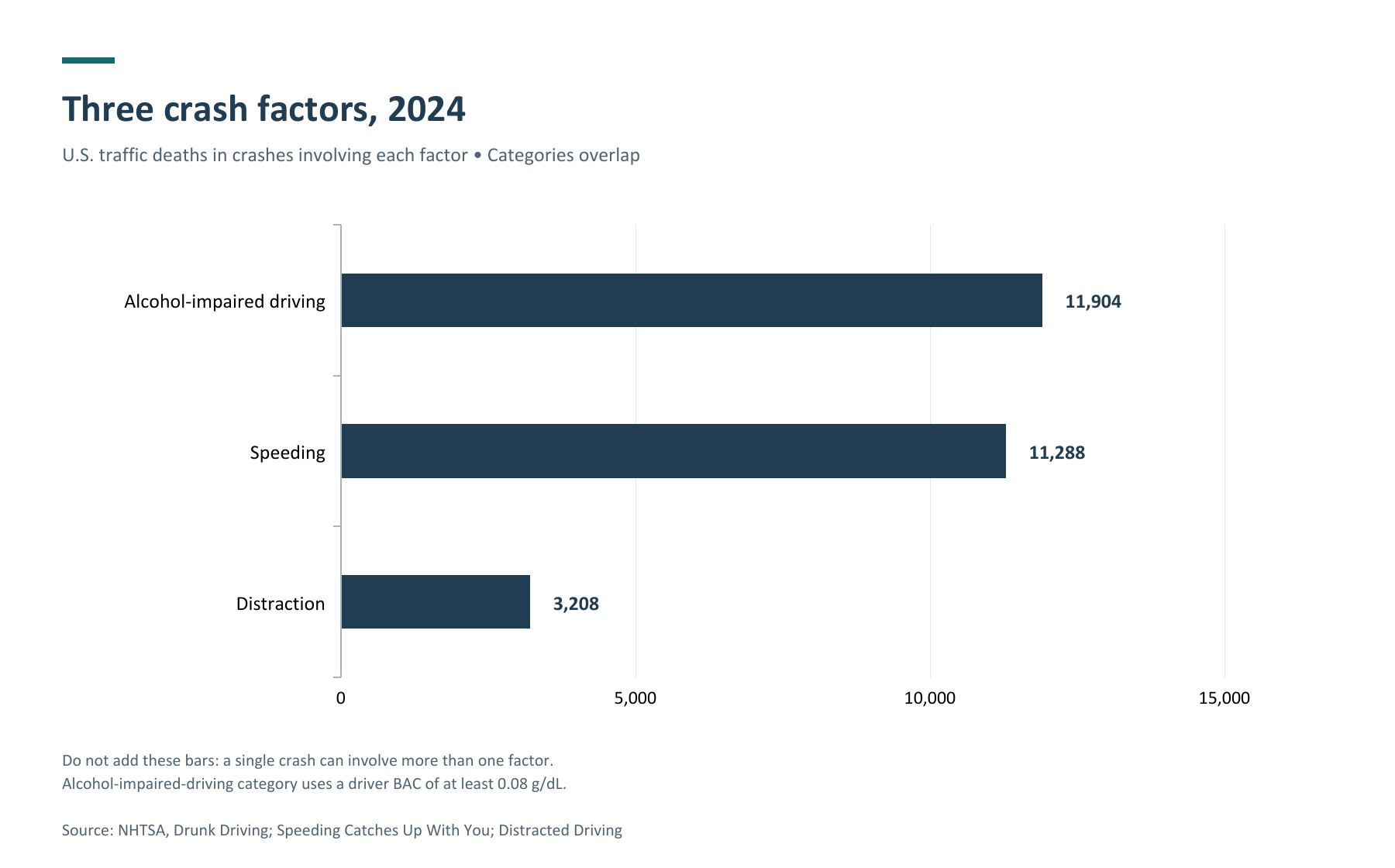
NHTSA reports 11,904 deaths in alcohol-impaired-driving crashes in 2024, approximately 30% of traffic fatalities. This category involves a driver with a blood alcohol concentration of at least 0.08 g/dL; it is a statistical definition, not a substitute for the applicable legal standard in an individual case.⁹
For speeding-related crashes in 2024, NHTSA reports 11,288 deaths, 29% of traffic fatalities, and 316,757 injured people.¹⁰
NHTSA reports 3,208 deaths and an estimated 315,167 injured people in crashes involving distracted drivers in 2024. Distraction includes more than phone use.¹¹
Drowsy driving and limitations of police reporting
A March 2024 AAA Foundation for Traffic Safety study estimated that 17.6% of fatal crashes during 2017–2021 involved a drowsy driver, with 29,834 deaths in those crashes over the five-year period. The study used in-depth crash investigations to model unobserved drowsiness among passenger-vehicle drivers. These are modeled historical estimates, not a direct 2024 police count, and should not be combined with the preceding chart.¹²
Uninsured and underinsured motorists
The Insurance Research Council estimated that 15.4% of drivers were uninsured in 2023 and 18.0% were underinsured. Underinsured drivers had liability coverage insufficient for the injury losses arising from an accident they caused. The estimates describe different coverage shortfalls; they do not establish whether a particular claimant has uninsured/underinsured motorist benefits.¹³
Insurance claim costs and frequency
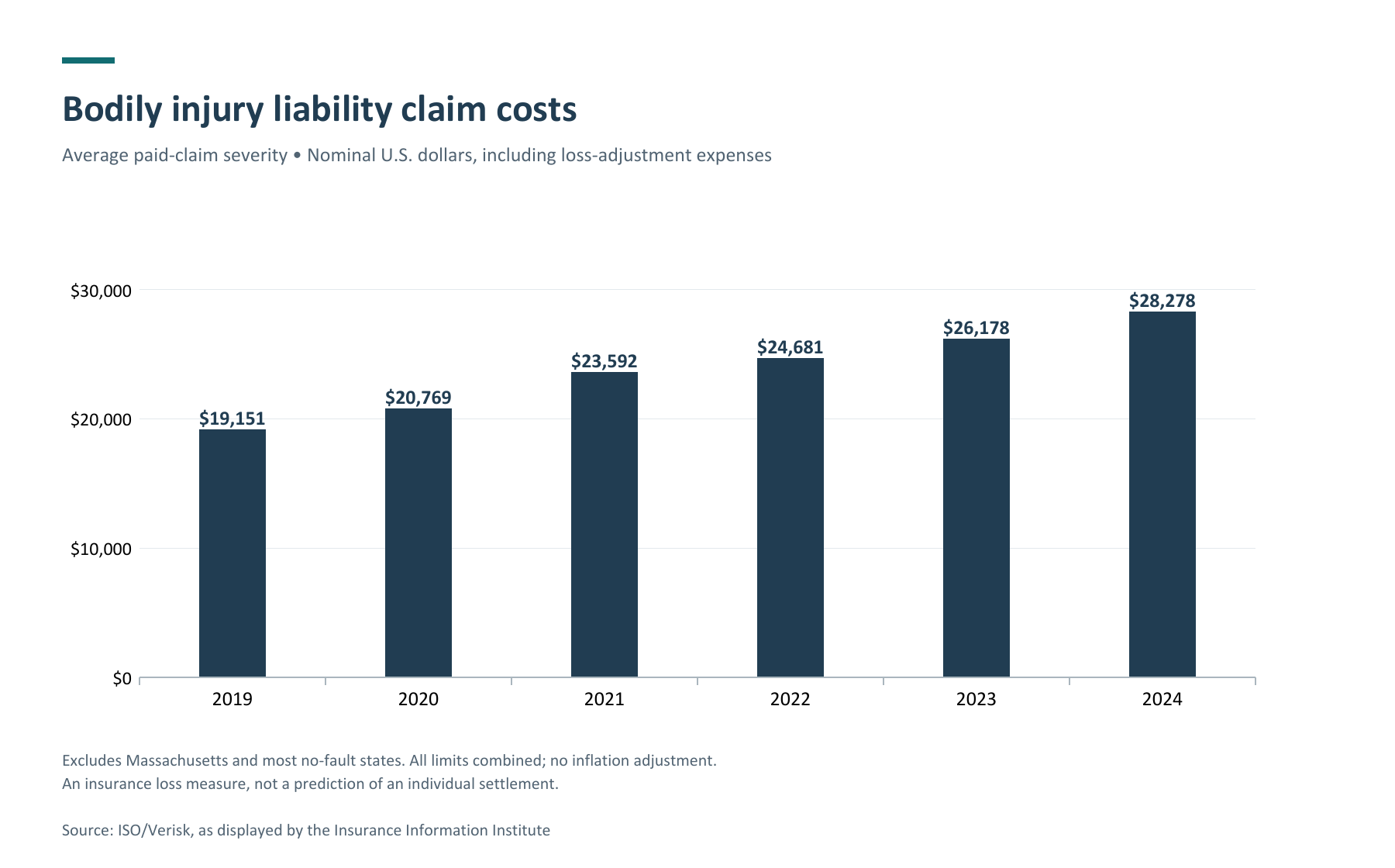
The Insurance Information Institute's ISO/Verisk table reports the following 2024 paid-claim statistics. Frequency means claims per 100 earned car-years; one car-year is 365 days of insured coverage for one vehicle. Liability severity includes loss-adjustment expenses.¹⁴
| Coverage | Average claim severity | Claims per 100 earned car-years |
|---|---|---|
| Bodily injury liability | $28,278 | 0.80 |
| Property damage liability | $6,770 | 2.50 |
| Collision | $5,489 | 4.16 |
| Comprehensive | $2,306 | 3.95 |
Bodily injury data exclude Massachusetts and most no-fault states; property damage excludes Massachusetts, Michigan, and New Jersey. Physical-damage data exclude Massachusetts, Michigan, and Puerto Rico and use $500-deductible coverage. Comprehensive excludes wind and water losses but includes glass. These averages cover different insured populations and are not personal settlement estimates.
Work, age, prevention, and economic burden
Several other datasets describe aspects of collision risk without measuring the same population:
| Source and observation period | Finding | Interpretation limit |
|---|---|---|
| Bureau of Labor Statistics, 2024 | Transportation incidents accounted for 1,937 occupational fatalities, or 38.2% of fatal work injuries.¹⁵ | Includes transportation events beyond passenger-car crashes; may overlap road-safety counts. |
| CDC, 2021 injury data | More than 200,000 adults aged 65 or older received emergency-department treatment for crash injuries.¹⁶ | Historical emergency-care measure; not every crash injury or a current-year total. |
| IIHS study reported in 2016 | Automatic emergency braking was associated with 50% fewer rear-end crashes and 56% fewer rear-end injury crashes in the study.¹⁷ | Historical system-effectiveness study; not a guarantee for every vehicle or crash situation. |
| NHTSA, 2019 economic burden | Crashes caused an estimated $340 billion in economic costs; including lost quality of life brought societal harm to approximately $1.4 trillion.¹⁸ | Valuations for 2019, including reported and unreported crashes; not current dollars or lawsuit awards. |
The practical lesson is to use each statistic for the question it answers. A national fatality trend describes public safety. A claim-cost average describes an insurance dataset. Neither determines negligence, insurance coverage, or compensation for a particular injured person.
Fault, negligence, and legal liability
Negligence concerns a failure to use legally required care that causes harm. Four familiar questions organize the analysis; actual and proximate causation are often described separately.¹⁹
| Element | Question in a collision investigation |
|---|---|
| Duty | What duty of care applied to the conduct? |
| Breach | What evidence shows a failure to meet that duty? |
| Causation | Did the conduct actually cause the harm, and is the connection legally sufficient? |
| Damages | What injury or loss resulted? |
A traffic citation, vehicle damage photograph, or witness account may address only part of that analysis. A complete review distinguishes the driver's conduct, the sequence of impacts, the claimed injuries, and the supporting records. The fact that a crash happened does not answer every element.
Comparative negligence and contributory negligence
Comparative negligence allocates responsibility among parties. A pure comparative system can reduce recovery by the claimant's share of fault; a modified system can also bar recovery at a specified threshold. Contributory negligence can bar recovery when the claimant's own negligence contributes, subject to the jurisdiction's rules and exceptions. State law determines the applicable system.²⁰
For an arithmetic illustration only, if legally recoverable damages were $100,000 and an applicable rule reduced them by 20% for claimant fault, the result before other deductions would be $80,000. That calculation assumes recovery is permitted. It does not establish a jurisdiction's threshold, an allocation of fault, or a case value.
Evidence in a car accident claim
A useful file explains what happened, what changed afterward, and which records support each point. NAIC recommends collecting driver and insurance information, witness contacts, the responding officer's details, the crash-report number, and information about time, location, weather, and road conditions. Photographs or a scene diagram can help preserve observations. Safety comes first; call 911 when someone is injured and document the scene only when safe.²¹
Organizing the crash record
The following is a practical organizing checklist. Availability, access rights, and relevance differ by case.
| Record | What to organize | Question it can help investigate |
|---|---|---|
| Crash report | Agency, report number, date obtained, diagrams, supplemental reports | What did the officer observe or record, and what came from others? |
| Photographs and video | Original files, capture dates, vehicle positions, road signs, damage | What conditions and physical details were visible? |
| Witness information | Names, contact details, where each person was located | What could the witness actually see or hear? |
| Vehicle records | Repair estimates, inspections, ownership, towing and storage paperwork | What damage and vehicle history need further analysis? |
| Medical documents | Visits, diagnoses, prescriptions, referrals, bills, and payment explanations | What care occurred, when, and for which reported problems? |
| Employment records | Job duties, pay records, time missed, restrictions | What work or income changed? |
| Insurance correspondence | Policy documents, claim numbers, letters, offers, contact log | What coverage positions or payment decisions have been communicated? |
Preserve original files alongside working copies. A concise timeline helps distinguish firsthand observations from later recollection or information supplied by someone else. Record uncertainties as uncertainties rather than filling gaps with assumptions.
Event data recorders and accident reconstruction
An event data recorder (EDR) can capture crash-related vehicle information, potentially including speed, braking, seat-belt status, and airbag deployment. The available information depends on the vehicle and system. NHTSA's EDR materials describe their use in crash analysis. An EDR is not a universal video record and does not independently decide legal responsibility.²²
An accident reconstruction expert may examine physical evidence and vehicle information. Other experts may address medical causation, future care, vocational limitations, or financial losses. Expert testimony relies on specialized knowledge and is subject to applicable evidentiary requirements. The necessary expertise depends on the actual disputed issue; every claim does not need every type of expert.²³
Injuries, medical records, and recovery
An injury file should accurately reflect symptoms, diagnoses, treatment, and functional limitations. Medical decisions belong with qualified health professionals. Legal documentation should describe what happened rather than suggest a diagnosis or direct treatment for the purpose of increasing a claim.
Concussion symptoms can emerge immediately or over subsequent hours or days. CDC identifies possible changes in thinking, balance, mood, and sleep. After a possible head injury, emergency danger signs such as a worsening persistent headache, repeated vomiting, seizures, unusual confusion, or inability to wake require immediate emergency care.²⁴
Useful records include discharge instructions, follow-up appointments, diagnostic reports, itemized bills, and work restrictions. A personal log can record daily activities that became difficult, with dates and concrete examples. It should distinguish what a clinician diagnosed from what the person experienced or suspected.
Questions about prior symptoms or earlier injuries call for a complete, accurate history. A medical record can show treatment and reported symptoms, but the legal question of what the collision caused may require additional analysis. A future-care claim also needs a basis for what care is expected and why, rather than a general assumption that treatment will continue indefinitely.
Insurance coverage and the claims process
Several coverage types can matter after a collision. The NAIC describes bodily injury liability, property damage liability, collision, uninsured/underinsured motorist protection, medical payments, and personal injury protection. Availability, limits, exclusions, and payment order depend on the policy and state.²⁵
| Coverage | Basic role |
|---|---|
| Bodily injury liability | Addresses covered injuries for which an insured is legally responsible. |
| Property damage liability | Addresses covered damage to another person's property. |
| Collision | Addresses covered collision damage to the insured vehicle, subject to policy terms and deductible. |
| Uninsured/underinsured motorist (UM/UIM) | Can address covered losses when the responsible driver lacks adequate liability coverage. |
| Medical payments (MedPay) | Can pay specified medical expenses for covered people, subject to limits. |
| Personal injury protection (PIP) | Can provide specified injury benefits, potentially including medical expenses and lost income. |
The declarations page is a starting point for identifying coverage and limits; endorsements and the full contract may also matter. A claim involving several injured people or policies requires attention to which limits apply and which coverage responds.
No-fault coverage does not eliminate every fault issue
No-fault insurance generally allows specified injury benefits through an insured person's own coverage without first establishing another driver's fault. State systems may restrict certain tort claims or require a threshold before some damages can be sought. “No-fault” does not mean that every claim, every type of damage, or every collision is handled identically.²⁶
Subrogation and reimbursement
Subrogation is the substitution of one party into another's legal rights. An insurer that pays a covered loss may, for example, obtain rights to pursue the responsible party. This helps explain why payments already made can affect later recovery discussions. The actual rights and obligations require review of the governing law and contract.²⁷
Keep a running record of who billed, who paid, what remains outstanding, and what reimbursement has been requested. “The bill was paid” and “nothing will have to be repaid” are different propositions. A proposed settlement distribution should make any unresolved payment issues visible.
Compensation, damages, and settlement value
Compensatory damages address legally recognized losses. Economic losses can include medical expenses, lost earnings, and property damage. Noneconomic losses may address pain, suffering, and other effects that are not simply an invoice. Punitive damages serve a different purpose and are available only under applicable legal standards.²⁸
| Loss category | Useful supporting material |
|---|---|
| Past medical expenses | Bills, records, payment explanations, and balances |
| Future care needs | Medical opinion, treatment plan, and supported cost estimates |
| Lost wages or income | Pay records, attendance, contracts, or business records |
| Reduced earning capacity | Evidence of lasting functional limits and their effect on work |
| Property damage | Inspection records, repair estimates, valuation documents, and receipts |
| Pain and effects on daily life | Specific descriptions, clinical records, and relevant witness observations |
Why an average settlement is not a valuation method
A settlement number without its context can conceal disputed fault, policy limits, multiple claimants, medical expenses, fees, and reimbursement obligations. A published insurance average may also exclude particular states or include insurer expenses, as the statistics section explains.
A useful evaluation instead identifies the facts that are established, the facts in dispute, the recoverable loss categories, and the practical sources of payment. It should distinguish a possible gross recovery from the amount ultimately distributed to the client. A formula that simply multiplies medical bills cannot resolve those questions.
Medicare, liens, and tax treatment
Medicare can make conditional payments for care when another payer may be responsible. Its recovery process can require reimbursement after a settlement, judgment, award, or other payment. Identifying and resolving the relevant conditional-payment amount is part of understanding the distribution; a preliminary amount is not necessarily the final demand.²⁹
Federal tax treatment also depends on the payment's character. IRS guidance distinguishes compensatory payments for personal physical injury or physical sickness from categories such as punitive damages. Earlier deductions for medical expenses can matter. A broad assertion that every car accident settlement is tax-free is inaccurate.³⁰
Contingency fees and case expenses
A contingency fee makes the lawyer's compensation depend on an agreed outcome or recovery. Case expenses are a separate issue. Under ABA Model Rule 1.5, a contingent-fee agreement specifies the calculation, expense deductions, and whether expenses come out before or after the fee; the model also addresses a written closing statement. State rules and the actual agreement control.³¹
Reading the written fee agreement
Before agreeing to representation, identify the percentage or other calculation, any changes at different case stages, and who pays expenses if there is no recovery. Ask which services are included, how unusually large expenses are approved, and what happens if representation ends early. “No fee unless recovery” should not be assumed to answer every question about costs.
The following illustration uses an arbitrary 30% fee, a $100,000 gross recovery, and $10,000 in expenses. It does not represent a market rate, a quoted agreement, or an expected outcome.
| Hypothetical calculation | Fee on gross recovery | Fee after expenses |
|---|---|---|
| Fee calculation | $100,000 × 30% | ($100,000 − $10,000) × 30% |
| Attorney fee | $30,000 | $27,000 |
| Expenses | $10,000 | $10,000 |
| Remainder before other obligations | $60,000 | $63,000 |
The $3,000 difference comes entirely from the calculation order. Medical balances, liens, reimbursements, taxes where applicable, and other obligations are excluded from both examples.
State laws and filing deadlines
A statute of limitations limits the time to bring a legal action. The applicable period can depend on the claim and jurisdiction, and the rule for when time begins can be as important as the number of years. A national topic cannot supply one deadline for every collision.³²
The following questions define a deadline review rather than a schedule to rely on:
- Where did the collision occur, and where might a lawsuit properly be brought?
- Which claims are being considered: personal injury, property damage, wrongful death, or another theory?
- When did the relevant harm occur or become discoverable under the governing rule?
- Does a public entity or government vehicle require a separate notice process?
- Are age, legal incapacity, or other circumstances relevant to a possible exception?
- What policy notice, proof-of-loss, service, or procedural requirements must also be checked?
A claim negotiation should not be treated as confirmation that all filing requirements have been satisfied. A reliable deadline assessment identifies the applicable statute or rule, the relevant dates, and any unresolved issue. The source-check date on a reference page is not a calculation of a reader's deadline.
Settlement negotiations and car accident lawsuits
Settlement evaluation brings together liability, documented loss, insurance information, and the uncertainty of further proceedings. A demand package can organize those subjects, but sending one does not compel an offer or establish a payment deadline for every insurer and jurisdiction.
From complaint to trial
The U.S. Courts' description of federal civil cases explains a sequence involving a complaint, service, responses, discovery, possible settlement, and trial where necessary. State courts have their own procedures. Discovery can include documents, written questions, and depositions; disputes may also be addressed through motions.³³
| Stage | Practical question to resolve |
|---|---|
| Initial assessment | What facts, claims, parties, coverage, and deadlines need investigation? |
| Evidence collection | Which records are available, missing, or disputed? |
| Loss documentation | What treatment, expenses, work changes, and future needs are supported? |
| Negotiation | What offer is being made, what would it resolve, and what remains uncertain? |
| Litigation, if filed | What court orders, discovery duties, and procedural dates apply? |
| Resolution and distribution | What agreement or judgment governs payment, and how are deductions documented? |
Timing, releases, and informed decisions
Duration depends on the issues that actually need resolution: the evidence, medical prognosis, coverage, number of parties, court scheduling, and willingness to agree. A short investigation and an expert-intensive lawsuit cannot be assigned the same reliable timetable.
Before deciding on an offer, identify the claims and parties a release would cover, the proposed payment terms, and the effect of outstanding expenses or repayment demands. The document's actual wording matters. A clear explanation of uncertainty is more useful than a promised result or an unsupported statement about what “all cases” settle for.
How to choose a car accident lawyer
Start with the lawyer's eligibility to practice in the relevant jurisdiction. The ABA's lawyer-licensing directory points to state agencies where professional status can be checked. Verify the individual who would handle the matter, not just a website brand.³⁴
Practice experience and certification are different concepts. The ABA describes lawyer specialty-certification programs; a lawyer's focus on car accident matters does not automatically mean the lawyer holds a recognized specialty credential. Any claimed certification should be identifiable and verifiable.³⁵
Comparing experience, scope, and communication
Ask about experience with the issue that makes the matter difficult, whether that is disputed liability, an uninsured driver, several policies, commercial use, or a lasting injury. Ask what evidence is needed before an assessment can be made. Past outcomes require context and do not predict another client's outcome.
Communication is also part of representation. ABA Model Rule 1.4 commentary addresses information needed for client decisions and consultation about important developments. Applicable state rules govern, but the practical expectation can be discussed at the first meeting: who communicates, how often, through which channel, and how urgent questions are handled.³⁶
Compare written terms as well as the conversation. A useful consultation should clarify the proposed work, the unresolved questions, the fee structure, and what the next step would be. It should not leave the reader guessing whether representation has actually begun.
For broader background on tort claims, negligence, evidence, damages, contingency fees, licensing, and professional duties, see Personal Injury Lawyer Wiki.
State-based firm websites
The Advocates in Colorado provides information about its Colorado personal injury legal services.³⁷
The Advocates in Idaho provides information about its Idaho personal injury legal services.³⁸
These are examples of state-based provider resources. Confirm the relevant lawyer's licensing, service area, and engagement terms directly. Their inclusion is not a comparative ranking or an assessment of a particular case.
Preparing for a car accident lawyer consultation
A compact chronology and organized documents make it easier to identify what is known and what needs work. The following preparation list does not require a complete case file before an initial conversation.
- Describe the event. Record the date, place, vehicles, people involved, and a concise account. Separate personal observations from information received later.
- Gather the crash information. Bring the report number, available report, photographs, video, and witness contacts.
- List care and symptoms. Include providers, dates, instructions, bills, and any restrictions already documented by clinicians.
- Explain the work impact. Note missed time, changed duties, pay records, and the difference between past income loss and a concern about future work.
- Collect insurance records. Include declarations pages, claim numbers, correspondence, offers, and any documents someone has asked you to sign.
- Identify earlier payments and obligations. List insurers or benefit programs that paid, unpaid balances, and reimbursement notices.
- Set out the questions. Ask about deadlines, missing evidence, representation scope, communication, fees, expenses, and how a settlement decision would be evaluated.
An honest “I do not know” is more useful than a guessed date or unsupported explanation. A consultation is an opportunity to identify missing information and determine whether the lawyer can assist. Keep a copy of any signed engagement agreement and written explanation of next steps.
Glossary of car accident law and insurance terms
| Term | Meaning in context |
|---|---|
| Adjuster | Person assigned to investigate or evaluate an insurance claim. |
| Bodily injury | Physical harm addressed by a claim or an insurance coverage definition. |
| Causation | The factual and legal connection between conduct and claimed harm. |
| Claimant | Person seeking payment or another remedy. |
| Comparative fault | Allocation of responsibility that can affect recovery under applicable law. |
| Contingency fee | Lawyer compensation calculated under an agreement tied to a recovery or outcome. |
| Damages | Money sought or awarded for legally recognized harm. |
| Deductible | Portion of a covered loss assigned to the insured under the policy. |
| Deposition | Testimony taken under oath during the discovery process. |
| Discovery | Formal exchange or collection of evidence in litigation. |
| EDR | Event data recorder; a vehicle system that may store crash-related information. |
| Liability | Legal responsibility. |
| MedPay | Medical payments coverage, subject to its terms and limits. |
| Negligence | Failure to meet a required standard of care that causes legally recognized harm. |
| PIP | Personal injury protection, a form of first-party injury-benefit coverage. |
| Policy limit | Contractual maximum for a specified coverage or category of payment. |
| Release | Agreement giving up specified claims or rights. |
| Settlement | Agreement resolving some or all disputed claims. |
| Statute of limitations | Legal time limit for starting an action. |
| Subrogation | One party's assumption of another party's legal rights. |
| UM/UIM | Uninsured and underinsured motorist coverage. |
| Wrongful death | A statutory civil claim arising from a person's death. |
Sources and editorial method
The statistical sources include NHTSA, CDC, the Bureau of Labor Statistics, the Insurance Research Council, the Insurance Information Institute, the AAA Foundation for Traffic Safety, and IIHS. Legal explanations draw on Cornell's Legal Information Institute, ABA materials, the NAIC, federal courts, CMS, and the IRS.
Observation years are shown separately from the source-check date. Projections, modeled estimates, insurance datasets, and hypothetical calculations are labeled. Counts from overlapping datasets are not added together. The footer gives full source titles and plain-text URLs so the underlying material can be checked.
This is general U.S. legal information. Applicable law, policy language, and individual facts determine a particular matter. No named attorney review, national law-firm affiliation, or promise of recovery is asserted.